In this article we will look at Japanese honorific language, called keigo (敬語), and suggest how you might use it in the course of an interview.
Broadly speaking, keigo is divided into three main categories: sonkeigo (尊敬語) or “respectful language”, kenjōgo (謙譲語) which is “humble language”, and teineigo (丁寧語) which is “polite language”. When you use sonkeigo you are showing respect by raising the status of the person you are addressing. When you use kenjōgo you are showing humility by lowering your own status. Teineigo is simply the use of the polite sentence ending desu and the verb ending –masu.

Below are some examples of the different forms of common verbs in each of these categories. There are often two or more options when using sonkeigo or kenjōgo.
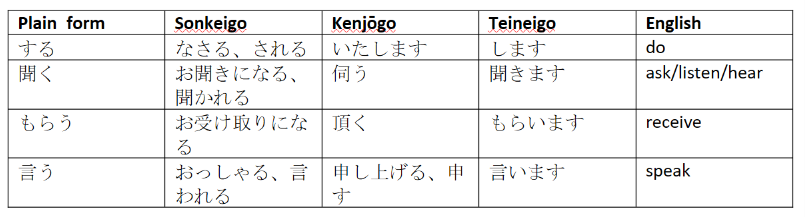
Let’s look at some examples of how these words might be used in the course of an interview.
Sonkeigo
Sonkeigo is used to describe the actions of your superiors, which in this case is anyone from the company that you are applying to. For example, a respectful form of the verb する (do) is される. In an interview you might use it like this:
「御社がこの役職に期待される点を教えてください。」
onsha ga kono yakushoku ni kitai sareru ten o oshiete kudasai.
“Could you tell me what expectations your company has for this position?”
Suppose you want to pass a copy of your resume to an interviewer. You would use the
formお受け取りになる for “receive” like this:
「どうぞお受け取りください。」
dōzo ouketori kudasai
“Here you are.” (Literally: “Here, please receive this”)
Or if asked how you became interested in this company you might say:
「御社の鈴木様がおっしゃった中で印象に残った言葉がありました。」
onsha no Suzuki-sama ga osshatta naka de inshō no nokotta kotoba ga arimashita.
“I was impressed by something that Mr. Suzuki from your company said.”
Kenjōgo
Kenjōgo is used to describe your own actions. For example, the humble form of する (do) is いたします. You can use this as you enter and exit the interview room:
「失礼いたします」
shitsurei itashimasu.
“Excuse me.”
If you want to ask a question, you can use 伺う instead of 聞く.
「配属先について伺ってもよろしいでしょうか。」
haizoku-saki ni tsuite ukagatte mo yoroshii deshō ka.
“May I ask about the location I would be assigned to?”
And if you have received something, then you can use 頂くinstead of もらう.
「本日は貴重なお時間を頂き、ありがとうございます。」
honjitsu wa kichōna o jikan o itadaki, arigatō gozaimasu.
“Thank you for giving me your valuable time today.”
Teineigo
It is important that you do not mix up your respectful language with your humble language. If you are not entirely comfortable with these forms, then it is better to stick with teineigo. Teineigo is polite enough for most situations and can be safely used for both your own and other people’s actions. No one expects a beginner or intermediate student of Japanese to have completely mastered keigo. In fact, most Japanese people do not become completely proficient with such language until they have experience using it in a business environment.
Full text by Micheál O’Luain. Top image made with AI. All rights reserved.
See also: The Dos and Don’ts of a Japanese Language Job Interview